After a big Poconos storm, the first question most homeowners ask is whether their insurance will cover the roof. The honest answer is: often yes, but it depends on what caused the damage and what your specific policy says. This guide explains how Pennsylvania homeowners insurance typically handles storm-related roof damage, so you know what to expect before you call your insurer.
One important note upfront. Ten Point Roofing installs and repairs roofs. We are not a public adjuster, and we do not file insurance claims on your behalf. What we do is inspect your roof, document damage with photos, and give you an honest written assessment of what we find — information you can share with your insurer and adjuster however you see fit. This post is education. For policy-specific questions, talk to your insurance agent or a licensed public adjuster.
How homeowners insurance generally treats storm damage
Most Pennsylvania homeowners policies cover sudden, accidental damage caused by a weather event. Wind, hail, and the weight of ice or heavy snow are the most common qualifying events here in the Poconos. What policies generally do not cover is damage from age, gradual wear, or maintenance that was put off.
So a roof that lost architectural shingles in a 60-mph windstorm is usually a covered loss. A 25-year-old roof with brittle, cracked shingles that shows new problems after a mild storm is a different story — the insurer will want to know whether the storm caused new damage or simply revealed deterioration that was already there.
That distinction matters. Adjusters are trained to spot it, and many PA policies have explicit exclusions for pre-existing conditions and deferred maintenance.
What's typically covered
Wind damage. Shingles lifted, creased, or blown off in a high-wind event. Shingles that look intact from the ground can still have broken seals that lead to leaks.
Hail damage. Impact bruising and granule loss from a hailstorm. Granule loss isn't always visible from the street, but it accelerates shingle aging and is a legitimate claim even before a leak appears.
Ice and snow load. Damage from the weight of accumulated snow or ice — a real concern at Poconos elevation. Ice dams that force water under shingles can reach the roof deck and cause interior damage.
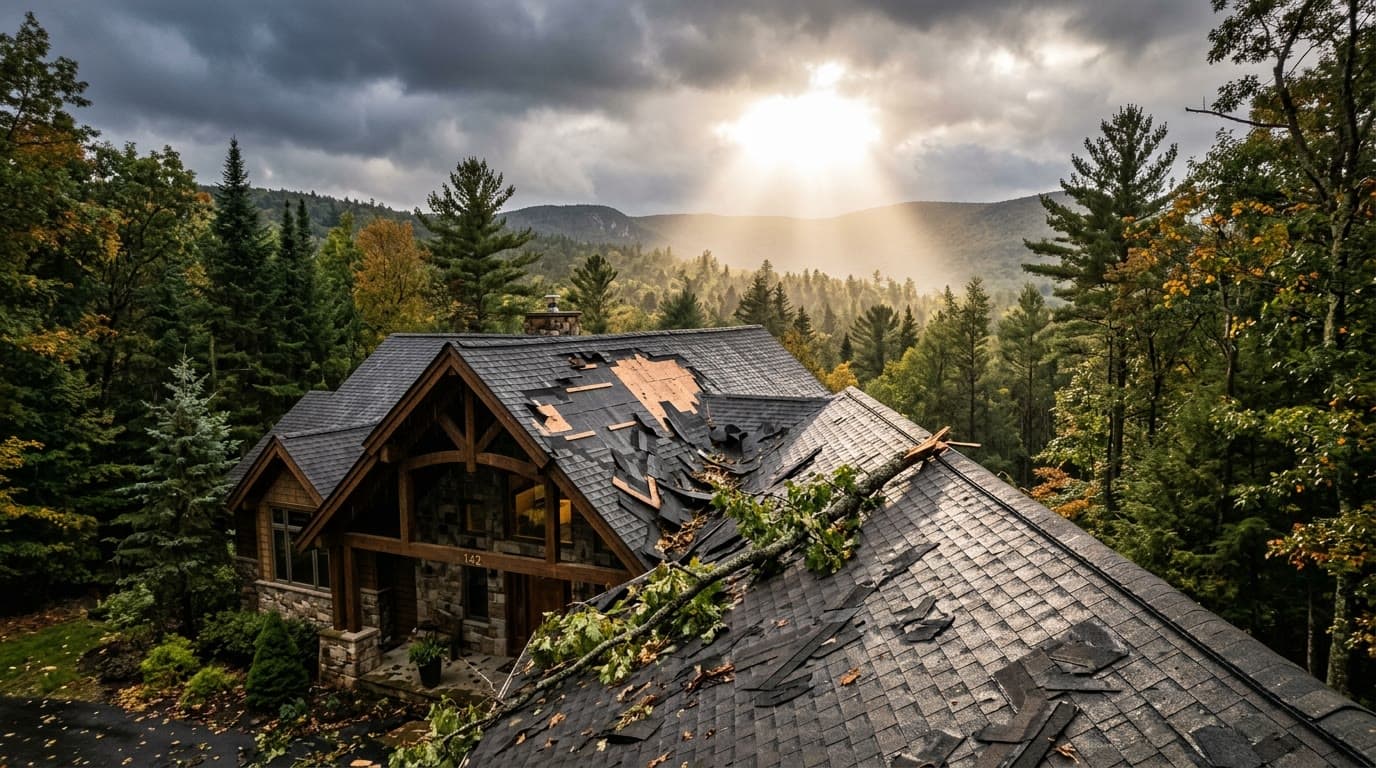
Falling objects. A tree limb that punches through the roof deck during a storm.
Resulting interior damage. Water damage to ceilings, walls, and insulation that follows a covered roof event is typically included as part of the same claim.
What's typically not covered
Normal wear and age. A shingle roof that has reached the end of its useful life is a maintenance issue, not an insurable event.
Deferred maintenance. If there was an obvious problem — missing flashing, a cracked shingle — that went unaddressed for years, the insurer may argue the resulting damage was preventable.
Cosmetic damage only. Some PA policies carry cosmetic damage exclusions. Dents or scuffs that don't affect the roof's ability to shed water may not be covered. Worth checking before you file, especially after a hailstorm where impact marks are visible but the roof is still functional.
Replacement Cost Value vs. Actual Cash Value
This is the most important policy term to understand before a storm hits.
Replacement Cost Value (RCV) means your insurer pays what it costs to replace the damaged portion with comparable new materials, minus your deductible. This is the stronger coverage.
Actual Cash Value (ACV) means the insurer subtracts depreciation from the payout. On a roof that's already 15 years old, that depreciation can be steep — leaving you well short of the actual repair cost.
Your policy's declarations page will show which type you have. If you're not sure, call your insurance agent and ask directly. Knowing this before a storm prevents a frustrating surprise when the settlement arrives.
How deductibles work
Your deductible is what you pay before your insurer covers the rest. Many Pennsylvania policies carry a flat dollar deductible — commonly somewhere in the $500 to $2,500 range. But some policies in our region also carry a separate wind or hail deductible calculated as a percentage of your home's insured value, typically 1 to 2 percent.
On a home insured for $400,000 with a 2 percent wind deductible, that's $8,000 out of pocket before coverage kicks in. It's worth knowing your deductible structure now, while the weather is calm, so there are no surprises when you file.
What to do after a storm
Document the date and the storm. Note when it happened and what it involved — wind speeds, hail size, duration. Local weather service records can confirm the event officially, which matters if a coverage dispute arises.
Get a professional roof inspection. Before you call your insurer, it helps to know exactly what is up there. A written inspection report with photographs gives you an accurate starting point and a record of conditions at the time of damage. Keep a copy.
Call your insurer and open a claim. Report the damage promptly. Most policies have notice requirements — waiting too long gives the insurer grounds to complicate or deny the claim.
Meet the adjuster. Your insurer will send an adjuster to assess the damage. You are allowed to have your own contractor on-site during that visit. A roofer can point out damage the adjuster might miss from the ground — compressed granule areas, lifted tab edges, failed step flashing. This is not adversarial; it's making sure the full picture gets documented before the adjuster closes the file.
Review the scope and estimate carefully. The insurer's approved scope should match the actual documented damage. If the approved estimate calls for partial repairs that don't address all the damage in the inspection report, you or a licensed public adjuster can request a supplemental claim. The first offer is not always the final answer.
Schedule the repair or replacement with a licensed local contractor. Once you have agreement on the scope, choose a roofer who is licensed in Pennsylvania, insured, and able to back the installation with a real manufacturer warranty — not just a verbal promise.
What makes a claim easier to support
A clear paper trail helps. That means: a dated inspection report with photos taken close to the storm event, a local weather record confirming the storm, and a written contractor estimate that itemizes materials and labor. Adjusters work from what is documented. Vague claims with no supporting evidence are harder to settle favorably.
This is why getting an inspection immediately after a storm — rather than waiting weeks — matters. The damage is fresh, the documentation is timely, and there is no question about when it happened.
A note on storm chasers
After any significant weather event, out-of-state crews roll into the Poconos. Some knock on doors within days of the storm, pushing homeowners to sign documents — sometimes assignment-of-benefits agreements that hand over insurance rights — before any real inspection has happened. These operations take their cut, do the minimum, and disappear. When something goes wrong with the installation, there is no one to call.
Work with a roofer who has a real local address and a local phone number. Ten Point Roofing is based in East Stroudsburg (25 S Courtland St). We are licensed (PA HIC #PA202073), insured, BBB Accredited, and GAF Master Elite certified — a designation held by the top 2 percent of roofing contractors in the country. We were here before the storm and we will be here after.
Never let anyone pressure you into filing a claim for damage that is not real. Insurance fraud carries serious consequences, and no short-term gain is worth it.
What Ten Point Roofing does
We inspect your roof top to bottom, photograph every area of concern, and give you a written report of what we found. That report belongs to you — share it with your insurer, bring it to the adjuster meeting, or use it to get a second opinion.
If your roof needs repair or a full replacement, we will give you a detailed written quote with no hidden costs. Our architectural shingle installations are backed by a GAF lifetime material warranty. Through the Golden Pledge program — GAF's highest coverage tier, available only through Master Elite contractors — that includes a 25-year manufacturer-backed workmanship warranty. Silver Pledge coverage carries a 10-year workmanship warranty. Both are transferable to a new owner if you sell.
We're local, licensed, and we stand behind our work.
Think your roof took storm damage? Schedule an inspection and get a quote or call (570) 212-9543.
Get a straight answer on your roof
Free, honest estimates across Monroe County and the Poconos. Stephen picks up.
570-212-9543