
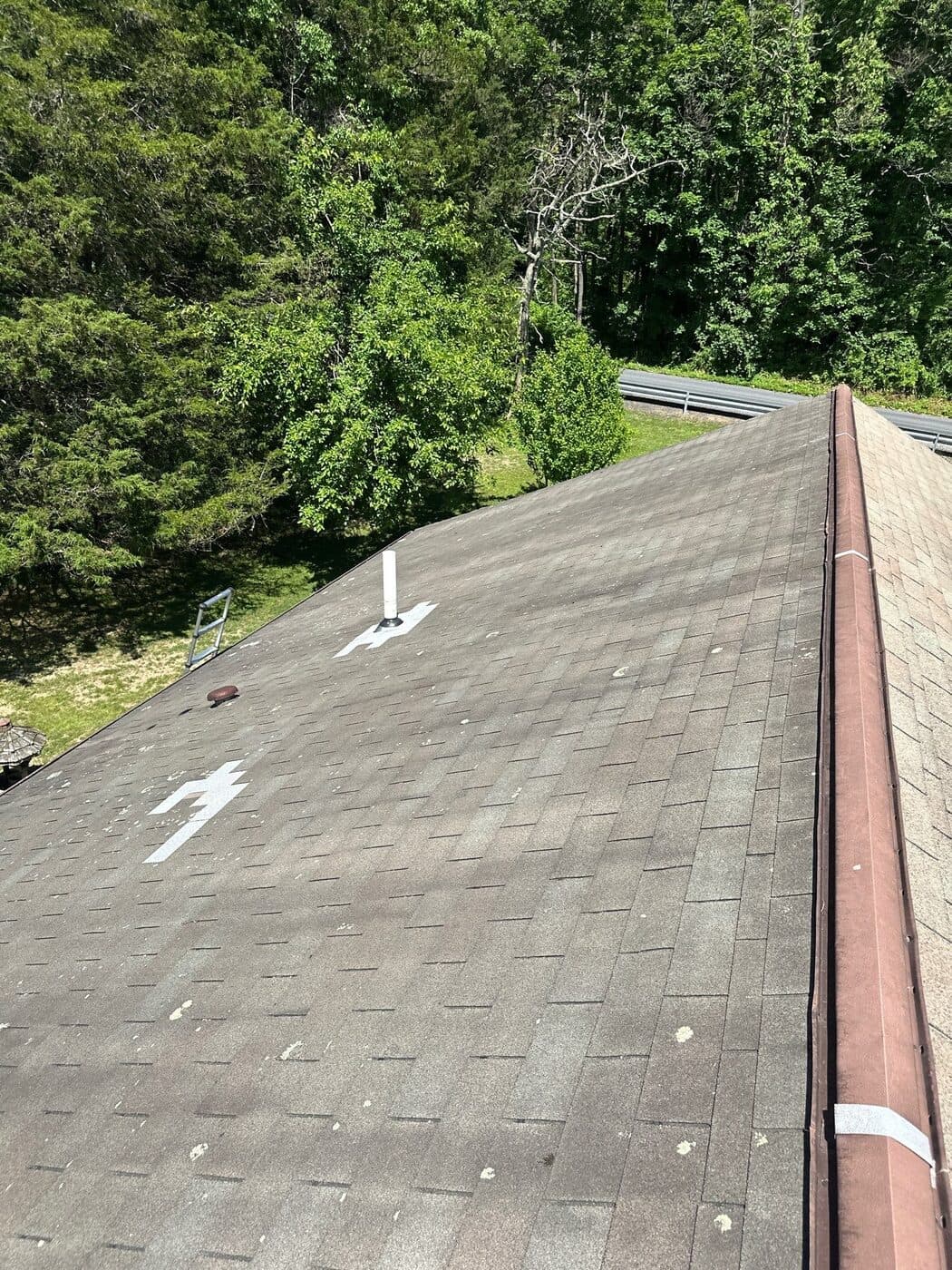
Roof Leak Repair in the Poconos
We trace leaks to their actual source — not just where they show up on the ceiling.
We trace leaks to their actual source — not just where they show up on the ceiling.
A stain on your ceiling is not a roof problem. It's a symptom of one. The actual entry point can be three feet away, or twenty feet away, or on a different slope entirely. Water travels. It follows the path of least resistance inside your wall cavities and across your decking, and it shows up where the insulation runs out or where the drywall is thinnest.
Ten Point Roofing traces leaks to their source. If that source is somewhere you wouldn't expect, we show you.
Common Sources of Roof Leaks
Flashing failure. The most common source. Flashing is the metal installed wherever your roof meets a vertical surface or a penetration: chimney, dormer, skylight, pipe boot, sidewall. When flashing sealant cracks, when metal corrodes, or when the flashing was never properly installed, water gets in at exactly that point.
Valley failure. Valleys — where two roof planes meet in a V — channel runoff from a large surface area through a small channel. When valley flashing wears out or valley shingles crack, this concentrated runoff finds its way through. Valley leaks often show up on interior ceilings well below the actual roof because the water travels along the valley framing.
Pipe boots. The rubber collars around plumbing vent pipes have a lifespan that's often shorter than the roof itself. The rubber dries out, cracks, and separates from the pipe. Water runs straight down the outside of the pipe and into the ceiling.
Ice dams. In Poconos winters, ice builds at the eave when heat from the attic melts snow higher on the roof. The melt water runs down to the cold eave, refreezes, and backs up under the shingles where ice and water shield isn't present. Ice dam leaks typically appear on interior ceilings near the exterior walls.
How We Find the Source
Finding a leak properly requires being on the roof during the right conditions, reading the evidence, and tracing the water path backward from where it appears inside. We inspect the entire roof — not just the area above the reported stain. We look at every flashing point, valley, penetration, and area of potential shingle failure.
We document what we find, show you photos where possible, and explain the diagnosis before any repair begins. You should understand what's happening and why we're proposing to fix what we're proposing to fix.
When a Leak Means Repair, and When It Means Replacement
Most leaks trace back to one failure point on a roof that's otherwise sound: a flashing seal, a cracked pipe boot, a worn valley. Fix that point and the roof is fine. That's most of the leak calls we get.
But a leak can also be the first visible sign of a roof that's reached the end of its service life. If the source traces back to shingles that are curling or losing their granule coating across a wide area, or if we find more than one active or previous leak point on the same roof, patching the current leak doesn't solve the underlying problem. It just delays the next one. We'll tell you which situation you're in, with photos of what we found, before any repair starts.
An aging roof shows more than leaks. For the fuller list, including curling shingles, granule loss, and a sagging roofline, see our guide on signs your Poconos home needs a new roof.
If you're dealing with an active leak, a full inspection is the fastest way to know which situation you're in.
Service Area
Get a Free Estimate
No pressure. Stephen will follow up — usually same day.
Or call directly: 570-212-9543
Common Questions
I've had the same area repaired twice and it still leaks. Why?+
Because the source was never properly identified. The repair addressed the symptom, not the entry point. This is the most common scenario we see on a second or third call. We start from scratch with the diagnosis and don't assume the prior repair work identified the correct location.
Can a leak cause structural damage?+
Yes. Sustained water intrusion damages roof decking (rot and delamination), insulation (which loses effectiveness when wet), and ceiling framing. If a leak has been active for a while, there may be more to repair than just the roof entry point. We flag this when we see it.
Do you handle leak repairs in winter?+
Yes. Winter leaks — often related to ice dams — are common in the Poconos. We address what we can access safely and what the weather permits. If an ice dam is active, we may recommend addressing the ice safely before the full repair can be completed.
Ready to talk?
Stephen answers the phone. Monday–Friday, 9am–6pm.