Most roofing problems give you warning before they become emergencies. The catch is that most of those warnings aren't visible from the driveway. Knowing what to look for — in the attic, in the gutters, and on the ceiling — can mean catching a fixable problem early instead of dealing with a structural failure on a January weekend.
Here are seven signs that a roof may be at or past the end of its life. Some point toward repair. Some point toward replacement. We'll be straight about which is which.
1. Curling, cupping, or buckling shingles
Healthy architectural shingles lie flat against the roof deck. When you start to see edges turning upward at the corners or the center of a shingle lifting away from the deck — sometimes called clawing or cupping — the material has aged significantly.
In the Poconos, our freeze-thaw cycles make this worse faster than it develops in warmer climates. Water gets under a slightly lifted shingle, freezes overnight, and levers the shingle further apart. By the time you can spot it from the ground, the process has usually been going on for a while.
A few isolated curling shingles in a specific area — sometimes caused by a ventilation problem — can occasionally be addressed with targeted repairs. Widespread curling across the whole roof surface means the material has aged out. Patching it at that stage is putting money into a surface that needs replacement.
2. Granules in the gutters or bald spots on shingles
The gritty mineral coating on asphalt shingles — the granules — serves a real function: it protects the asphalt underneath from UV breakdown and gives the shingle its weather resistance. When that coating starts shedding heavily, the material underneath degrades quickly.
Some granule loss in the gutters is normal on a very new roof (manufacturing excess) and on a roof that's very old (end of life). If your roof is 15 or more years old and you're finding significant granules in the downspouts after rain, or you can see bald patches on shingles from the ground, the roof's protective layer is failing.
In our climate, shingles with substantial granule loss are more vulnerable to ice and snow damage. The exposed asphalt becomes brittle in cold weather and doesn't bond the same way to ice barriers as a surface in good condition.
3. Light or moisture in the attic
This one is worth checking from inside the house. On a bright day, go into the attic and let your eyes adjust to the dark. If you see daylight coming through the roof deck — even small pinpricks — water can follow the same path. Roofing is about layers; any breach in the deck that lets light through lets water through.
Look at the rafters and decking while you're up there. Dark streaks, soft or spongy wood, or a musty smell all mean moisture has been getting in. In our climate, attic moisture compounds quickly: mold sets in, insulation becomes saturated and loses its R-value, and the roof deck itself can begin to rot, which is a structural issue, not just a shingle issue.
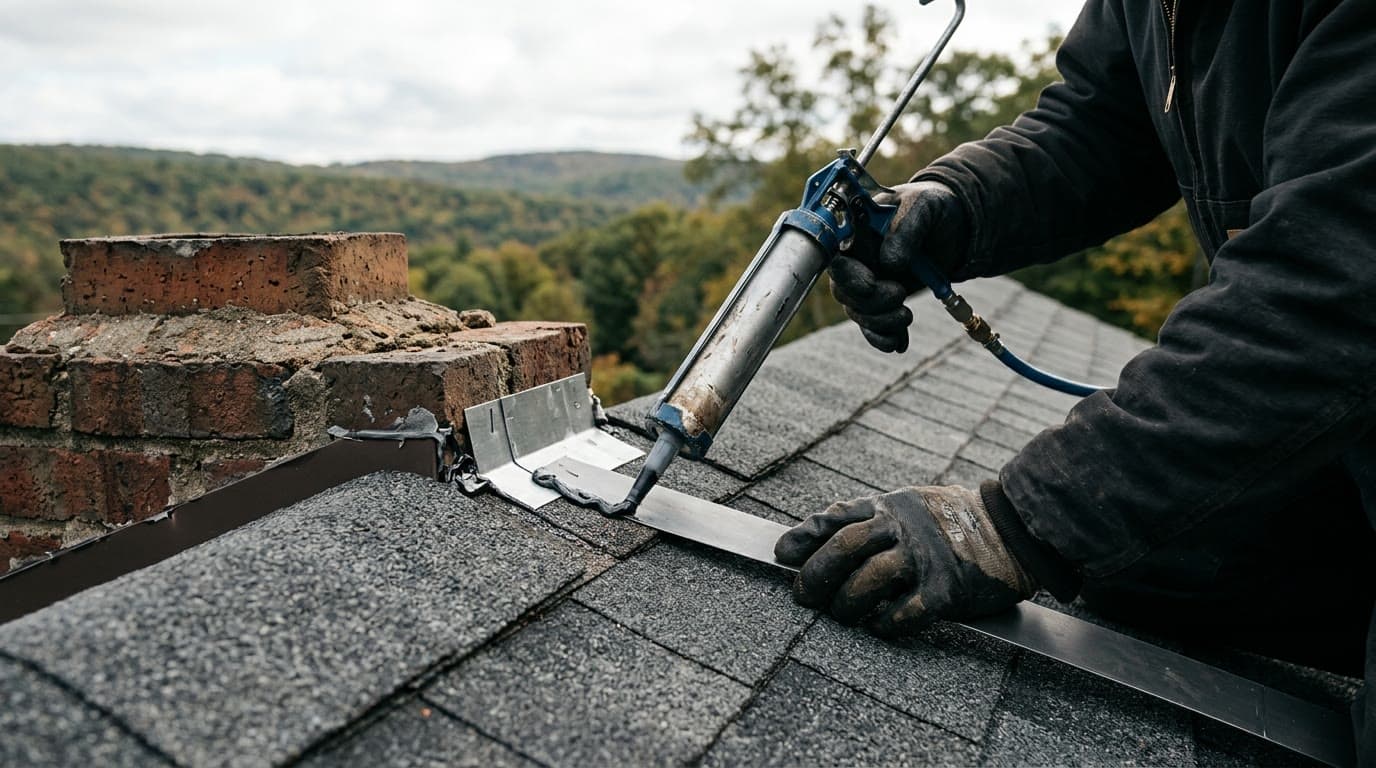
An attic problem doesn't automatically mean full replacement. Sometimes it traces back to a failed flashing at a chimney or skylight that can be isolated and repaired. But widespread staining and soft decking throughout the attic usually means the roof needs to come off to address the underlying damage properly.
4. Ceiling stains or active leaks inside the house
Water stains on ceilings and walls — brown rings, discolored drywall, peeling paint around a light fixture — tell you water has already made it past the roof and into the living space. By the time you're seeing interior signs, the damage is further along than the roof surface alone would suggest.
The entry point and the stain are often not in the same location. Water travels along rafters, over vapor barriers, and around insulation before it finally shows up on your ceiling. A professional inspection traces it back to the actual source.
Active leaks during a storm are an emergency. Poconos winters don't give you weeks to schedule a contractor. Call quickly when you see active water intrusion — the longer a leak runs, the more expensive the secondary damage to insulation, framing, and drywall.
5. A sagging or uneven roofline
Step back from your house and look at the roofline from the street. It should be straight and true from ridge to eave. If you see dips, waves, or sections that sag between the rafters, that's a structural signal, not just a cosmetic one.
Sagging typically means the roof decking has lost its rigidity, usually from prolonged moisture exposure that has caused it to delaminate or rot. In more serious cases, the rafters themselves are compromised. This is not a shingle swap — it requires opening the roof and addressing the structural components underneath.
This one should not wait. Poconos snow loads are significant. A compromised roof deck that looked manageable in October can become a real safety concern by February when it's carrying the weight of heavy wet snow.
6. Ice dams forming every winter
An ice dam is the ridge of ice that builds along the eave when heat escaping from the house melts snow higher up the roof, and the runoff refreezes as it reaches the cold overhang. Ice dams themselves are partly a ventilation and insulation problem — heat should not be escaping through the roof deck at that rate. But they are also a symptom of a roof system that isn't managing water movement the way it should.
Left alone, ice dams force water back up under shingles. In a bad year, that water finds the roof deck, the insulation, and eventually the ceiling.
If you've had ice dams cause interior damage two or more winters in a row, it's worth a full evaluation: ventilation, insulation levels, and the condition of the ice-and-water shield at the eaves. A roof that's 15-plus years old and producing chronic ice dam problems has almost certainly lost the effectiveness of whatever ice protection was installed originally. A replacement gives you the chance to do the whole system correctly — proper ventilation, adequate insulation, and ice-and-water shield that covers the full vulnerable zone at the eave.
7. The roof is 20 or more years old
Architectural asphalt shingles — the standard for most Poconos homes — are lifetime products — GAF rates its architectural shingles for 50 years, and a properly installed, properly ventilated roof should deliver 30 to 40 years of real service in our climate. The freeze-thaw cycles, heavy snow loads, and UV exposure through summer punish shortcuts, so a roof that was installed or ventilated poorly ages out of that range early.
If you're not sure how old your roof is, check the permit history with Monroe or Pike County, look at disclosure documents from your home purchase, or simply have a roofer take a look. An experienced eye can estimate shingle age from the style, granule condition, and surface brittleness.
Age alone doesn't mean a roof needs immediate replacement. But if you're also seeing any of the signs above, the age tells you that money spent on repairs is going toward a surface that is already near the end of its service life. At that point, replacement typically makes more sense financially than continued patchwork — especially when a replacement done right includes a lifetime material warranty and up to 25 years of manufacturer-backed workmanship coverage.
When to call for an inspection
If you're seeing one or more of these signs, the right step is a professional inspection — not to commit to anything, just to know what is up there. Ten Point Roofing offers free roof inspections for homeowners throughout the Poconos. We get on the roof, document what we find with photos, and give you an honest written assessment.
We would rather tell you the roof has three good years left than sell you a replacement you don't need yet. If it does need work, we'll tell you honestly whether targeted repairs address the problem or whether a full replacement is the better path for your situation. We do not push replacement when a repair is the right answer.
Ten Point Roofing is licensed (PA HIC #PA202073), insured, GAF Master Elite certified, and based in East Stroudsburg. We serve homeowners throughout the Poconos — Stroudsburg, Mount Pocono, Effort, Albrightsville, Long Pond, Kunkletown, Delaware Water Gap, and surrounding communities.
Schedule a free roof inspection or call (570) 212-9543.
Get a straight answer on your roof
Free, honest estimates across Monroe County and the Poconos. Stephen picks up.
570-212-9543